Payments are experiencing issues due to temporary restrictions in Russia. If your payment does not go through, please submit a support request.•Our support team is available 24/7 — we are always here to help with hosting and server issues.•We are now accepting requests for dedicated server rental and colocation services in our data center.•Reminder: we recommend enabling backups for additional data protection.•A new VPS/VDS lineup with NVMe storage and improved performance is now available.•Maintenance work on some servers has been completed. All services are operating normally.•
Payments are experiencing issues due to temporary restrictions in Russia. If your payment does not go through, please submit a support request.•Our support team is available 24/7 — we are always here to help with hosting and server issues.•We are now accepting requests for dedicated server rental and colocation services in our data center.•Reminder: we recommend enabling backups for additional data protection.•A new VPS/VDS lineup with NVMe storage and improved performance is now available.•Maintenance work on some servers has been completed. All services are operating normally.•
Аккаунт в General iT
Вход / Регистрация
Войдите или создайте аккаунт для управления услугами в панели.
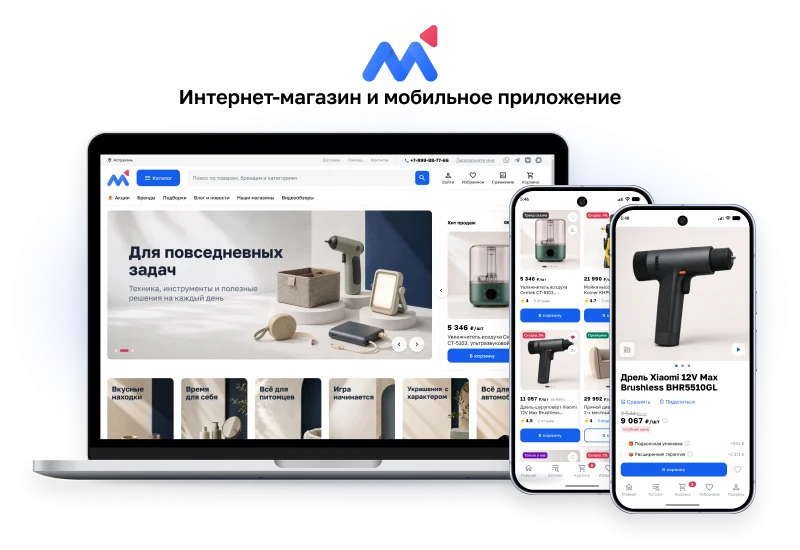
A unified solution for an online store and mobile applications on iOS and Android. The catalog, prices, stock levels, orders, and content are synchronized across all platforms. A single update in the system is immediately visible to buyers on both the website and the mobile apps.
A unified solution for an online store and mobile applications on iOS and Android. The catalog, prices, stock levels, orders, and content are synchronized across all platforms. A single update in the system is immediately visible to buyers on both the website and the mobile apps.
The demo version allows testing the full buyer journey: search functionality, filter application, product card viewing, and order checkout.
The site features a modern design with familiar navigation.
MarketPro provides customers with a fast, modern website while you continue managing the catalog and orders in the familiar 1C-Bitrix admin panel. The solution scales from small stores to projects with tens of thousands of items. The package includes a mobile application.
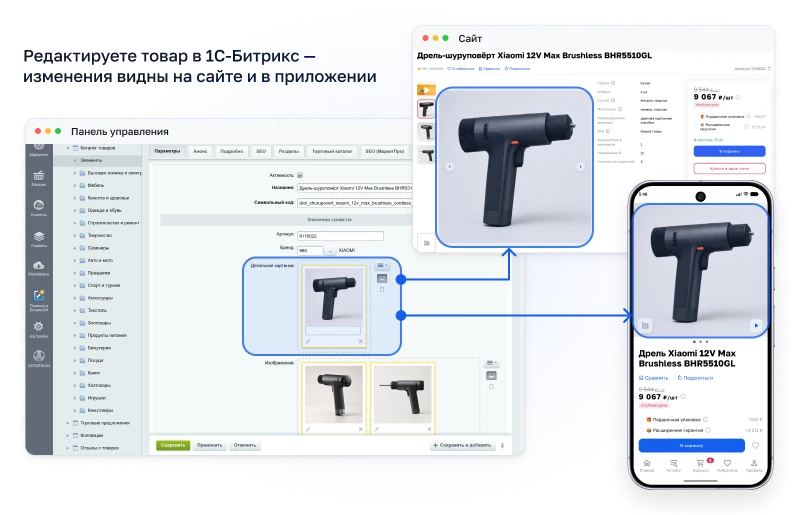
Any product action—adding an item, changing the price, launching a promotion, or placing a banner—is immediately visible to the buyer on both the website and the mobile application. The MarketPro solution includes full native applications for iOS and Android platforms. These applications are ready for publication in the Google Play and App Store, support push notifications, and utilize smartphone hardware capabilities.
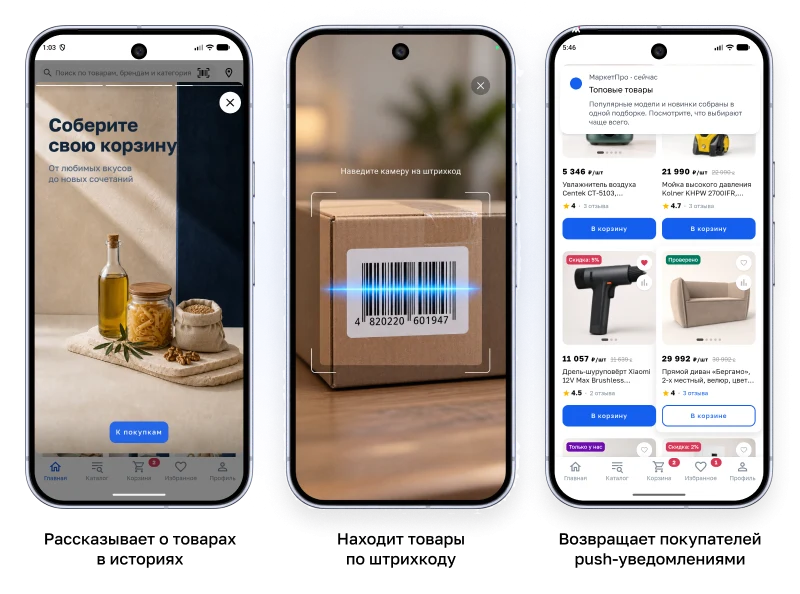
MarketPro is a template for an online store and mobile application by ASTDESIGN. The tool allows sending push notifications to all users or selected groups: announce promotions, new stock arrivals, or remind about a forgotten cart. For each campaign, data on sends, deliveries, and opens is visible.
A separate discount can be configured for orders placed via the application. When launching the app, stories with an image or short video containing a link to a promotion, collection, or product can be displayed.
Repeat purchases are simplified: the camera scans the barcode on the packaging and instantly finds the product. To promote the app on the website, an 'Open in App' banner and app store buttons are provided.
The user enters the first letters and immediately sees relevant products, categories, and brands grouped in suggestions. Search corrects typos and incorrect keyboard layouts, accounts for synonyms from the catalog, and saves query history. If needed, Yandex.Search for Stores, SearchBooster, or MultiSearch can be connected. Search by barcode via the camera is also available.
Filters in the catalog can be positioned on the left or above the product list. Next to each value, the number of matching items is displayed, allowing the buyer to immediately see if results exist. For price and numerical characteristics, a range selector appears automatically, while colors and textures are visualized using images.
In-stock items are always displayed first, with sorting within this group configurable by the user.
Quick links under the section header lead to ready-made collections filtered by key criteria: popular brands, price ranges, or specific characteristics. The list view style—grid or list—can be set individually for each section.
Product Card
The product card provides the buyer with essential information immediately: specifications, price, availability, delivery terms, and reviews.
Availability. The system shows where the item is available, listing specific stores or warehouses. Sales points can be displayed as a list or on a map.
Delivery. Delivery costs and timeframes are calculated automatically for the buyer's city directly within the card. For items located at the supplier's warehouse, the delivery date and a "We will deliver" label are shown, accounting for weekends and holidays.
Credit and Installments. The interface supports displaying multiple buttons: a bank application form, a custom application form, or a link with detailed terms.
Additional services. Assembly, lifting, installation, and extended warranty can be mandatory or optional. Pricing is set as a fixed amount or a percentage of the product price.
Bundles and add-ons. Product cards display sets, accessories, similar items, and related products.
Customer reviews. The system collects ratings, highlights pros and cons, allows photo uploads, and displays store responses. A request to leave a review is sent to the customer via email after a specified number of days following order completion.
Back-in-stock notifications. If an item is out of stock, the customer receives an email when it becomes available.
Product variants. Options are displayed as images, links, dropdown menus, or tables, whichever is most convenient for the buyer. When items are sold in packs or with a specific quantity increment, this information appears next to the selection field.
Checkbox-based cart. Customers select items to add to the current order; other items remain in the cart without being removed.
Clear cart goal. A progress bar indicates how much more needs to be added to qualify for free shipping, a gift, or a bonus.
The system reduces manual entry: suggestions speed up address completion, while for legal entities, details are automatically filled in based on INN and BIK. Data for regular customers is restored from past order history.
Pickup points are displayed on a map or as a list, allowing the buyer to select a convenient option directly during checkout.
Delivery costs are displayed transparently. If a rate is not predefined for the selected service, the text "To be confirmed by a manager" is shown.
Various login methods are available: SMS, incoming call, outgoing call to the buyer's phone, or email. In cascade mode, the code is sent first to Telegram, then to email, and finally via SMS.
Payments are configured using standard Bitrix tools. The solution has been tested with Sber, YooKassa, and Tinkoff. Unpaid orders can be paid later through the personal account.
The personal account includes order history, one-click order repeat, cancellation, online payment, a tracking number with a tracking link, and a chat with a manager within the order with file exchange capabilities.
The bonus system awards points for purchases, registration, and birthdays. Rules apply to specific products, customer groups, cities, and accumulated amounts. A spending limit per order is set, bonuses have an expiration date, and flash bonuses can be launched for all active customers for a few days.
MarketPro is a ready-made solution for creating an online store and mobile application by ASTDESIGN. The tool allows collecting visitor email addresses and issuing promo codes. You can flexibly configure the conditions for displaying pop-up windows: selecting specific pages, device types, and the timing of the offer.
The system supports creating dedicated pages for promotions and assembling product collections. Product cards can display tags such as 'New' or 'Bestseller', as well as custom labels, either manually or automatically based on defined conditions.
Email newsletters and push notifications are used to maintain customer engagement after purchase. These channels allow informing users about new stock arrivals, reminding them of abandoned carts, requesting reviews, awarding birthday bonuses, or delivering personalized messages from managers. The target audience for push campaigns is selected according to specific criteria.
Store management is performed through the Bitrix administration panel without modifying source code. Settings for design, catalog, search, order processing, sales geography, and the bonus system, as well as mobile application parameters, are configured in the same interface used for managing products and orders. Most changes appear on the storefront immediately. Some design and catalog settings require a rebuild, which typically takes between 5 and 10 minutes. During the content filling phase, the site can be temporarily hidden behind a placeholder. The solution enables simultaneous sales operations across multiple cities.
MarketPro: Online Store and Mobile Application
The system supports regional configuration for cities, groups of cities, or regions. The current region is determined automatically by IP address, while the buyer can change it manually. Each region has its own settings: assortment, prices, stock levels and warehouses, contact details, logo, organization name, text pages, sliders, and banners. Regions can operate within a single domain, on subdomains, or on separate domains.
Order Source Analytics
Allows creating dedicated pages for specific search queries. For selected combinations of filters and product characteristics, you can set a unique URL, text description, titles, and images for social networks.
Redirect Management
When the catalog structure changes, old page URLs are preserved. Visitors and search engines are automatically redirected to the new pages. Redirect rules can be added manually or imported from XLSX files; regular expressions are supported for complex scenarios.
Channel Tracking
UTM parameters and purchase channel information (desktop, mobile website, or application) are saved directly within the order.
Yandex.Metrica Integration
Provides access to sales funnel data in Yandex.Metrica. Supports e-commerce tracking and 14 goals: cart, favorites, comparison, standard order, quick order, one-click purchase, callback request, product subscription, and other actions.
Analytics, chat, and call tracking are connected via fields for external scripts without modifying the core solution.
Catalog population and data exchange
When selling on Wildberries, manual catalog entry is unnecessary. Product cards are automatically transferred from the seller's personal cabinet, including names, descriptions, images, video links, brand, specifications, dimensions, and weight. Reviews with ratings, photos, and seller responses are also imported. Products are matched by the seller's article number. New items are published immediately or after moderation, with updates scheduled to run automatically. A trial run is available before the first import.
Exchange with 1C is configured using standard Bitrix tools. Separate integration modules are available for MySklad and other accounting systems.
The system supports integration with Bitrix24, popular delivery and payment services, SMS services, address autocomplete, maps, and push notifications. The specific set of connections is selected based on your store's business processes.
Documentation, technical support, and updates
Comprehensive documentation provides installation instructions, a description of capabilities, and answers to frequently asked questions. Before purchasing, review the FAQ and verify that the solution meets your store's requirements.
If you have questions, contact details for the developer ASTDESIGN are available on their official website and in the 'Support' tab on the product page in the Marketplace.
Regular updates installed via the Bitrix administration panel include new features, improvements, bug fixes, and security vulnerability patches.
The source code is open for modification. You may adapt the solution to your specific needs without restrictions from the developer.
To evaluate the system, open the demo and complete the buyer journey on both the website and the mobile application.
MarketPro: Online Store and Mobile Application
Documentation with a complete list of capabilities. To find a specific feature, use the list below or check the FAQ before purchase. If the answer is not found, contact the developer ASTDESIGN support through their contacts or the Support tab in the Marketplace.
Storefront and design configuration. Nine color schemes are available, selectable from a palette or specified by HEX code. Support for over 200 fonts with Cyrillic characters. Logos can be uploaded in SVG and raster formats, with a separate version for the mobile site. The favicon is generated from a single file. Watermarks are applied to enlarged product images.
Adaptive site structure. Two header variants are provided for the desktop version and two for the mobile version. The header can be fixed, and a bottom action panel is available on mobile devices. The header displays the city, phone number with working hours, links to the catalog, search, cart, favorites, comparison, user login, and callback request.
Menus and navigation. The interface includes a top menu with dropdown submenus, a separate menu below the header, and an arbitrary catalog tree with section icons and brand logos. An expanded catalog menu is available on mobile devices. The header contains icons for messengers: Telegram, WhatsApp, VKontakte, and MAX.
Banners and footer. The stretch banner supports custom display dates, regional restrictions, and a separate image for mobile devices. The footer includes two menus, contact information, copyright notice, payment system icons, buttons for Google Play, App Store, and RuStore, and social media links.
The MarketPro template by ASTDESIGN includes a cookie notification and an option to hide the developer signature. The homepage features image and video sliders in two design styles with adjustable scroll speed. Available elements include a 'Product of the Day' block, stories, and categories displayed as a list or slider. The layout provides four slots for banners and four for product collections, along with blocks for brands, collections, videos, articles, news, and promotions. An arbitrary text block is placed at the bottom. Separate images are used for the mobile site and app, with content display configurable by date, city, and customer groups, and lazy loading is implemented for blocks.
The catalog and filters support sections and subsections with icons and images. Custom sorting is available, with subsections displayed above the product list. The list view can be set to grid or row format, applied globally or overridden for specific sections. Built-in sorting options include popularity, price (ascending and descending), rating, and discounts, plus the ability to create custom sorting by any field. In-stock items are always displayed first. The number of items per page and a 'Show More' button are configurable. The system supports displaying products with or without subsections, hiding empty sections and unavailable items. The list displays the article number, unit of measurement, stock quantity, rating, and review count.
MarketPro is a ready-made solution for creating an online store and mobile application. The product card interface supports properties with icons, a scrollable gallery, display of purchase bonuses, quick view in a separate window, and functions for comparison and adding to favorites. The system allows showing a specific trade offer instead of a general product, using the prefix 'from' for the minimum price, highlighting items with a background, and moving them to the top of the list. Filtering is available on the left or top by characteristics, price, availability, and specific warehouses. It includes counters of suitable items, value visualization, text and video hints, automatic range detection for numbers and prices, and a parameter reset button. Filter indexing and background image size generation are supported.
The search system offers hints grouped by products, sections, and brands, corrects typos and keyboard layout errors, and uses a synonym dictionary. A search mode by name only is available, along with the ability to narrow results by found sections, customer query history, and a search field on all mobile site pages. Barcode search is implemented via the camera in the app or input in the search bar on the site. Integration with Yandex.Search for stores, as well as SearchBooster or MultiSearch services, is supported.
Product card with a gallery supporting image zoom, magnifying glass, and keyboard navigation. Video embedding from YouTube and RuTube is supported. Attributes are grouped by section, enhanced with icons and tooltips; service properties are hidden, and long descriptions can be collapsed. The card displays the SKU, brand, brand country, and manufacturing country with flags. Size charts are linked to specific brands and categories, and files such as manuals, certificates, and passports can be attached. Stock availability is shown as a list or on a map for stores and warehouses, with delivery calculation based on the buyer's city. Supplier warehouse delivery time is displayed with a 'We will deliver' label, accounting for weekends. Options for credit and installment plans are provided via multiple buttons, alongside add-ons priced at a fixed rate or percentage. The card supports kits, sets, accessories, related products, recommendations, collections, and curated selections. Relevant promo codes are shown with a click-to-copy feature. Additional functions include product tags, quantity selection before adding to cart, 'Buy in one click', favorites, comparison, link sharing, back-in-stock notifications, and an 'Report description error' block with an inquiry log. The section menu and product photo remain fixed during scrolling.
MarketPro: online store and mobile application
Trading offers and product variants management. Supports classic offers with individual prices and stock levels, as well as linked variants connecting separate product cards. Switcher types include images, text links, dropdown lists, and tables displaying all values with quantities and a single 'Add to Cart' button. Quantity step settings allow for step-wise increments with visible labels. Switcher images can be sourced from product properties or specific offer photos. Selection filters are configurable globally and per section. Features include rules for selecting the active offer upon opening a card, visibility control for unavailable offers, hiding identical characteristics across all variants, and merging image galleries.
Review system. Features a five-star rating and overall product rating. Reviews appear in both the catalog and on product pages. Separate fields are provided for pros, cons, and general comments. Moderation is required before publication, and store responses to reviews are supported. A 'registered users only' mode is available with a 'one review per product' limit, or reviews can be accepted from any visitor by name. The system includes a helpfulness rating for reviews and a 'Most Helpful Review' block. Customer photos undergo separate moderation. Automated requests for reviews can be sent after a specified number of days following order completion. The entire review and rating functionality can be disabled.
Price, discount, and stock management. Supports an arbitrary number of price types with unique names, sorting, tooltips, and color coding. Prices are displayed separately in the product list and in the product card, accounting for buyer groups and cities. A price matrix «price per unit based on quantity» is implemented. The price type automatically switches depending on the cart total. Currency conversion and custom currency symbols are supported. Discounts are configured using Bitrix cart rules, including a dedicated discount for the application. The old price is displayed for the product and each offer with automatic percentage calculation. Gift-with-order functionality is available. The system shows exact stock levels, as well as stock by stores and warehouses. A public «Stores» section includes addresses, phone numbers, photos, and maps. The catalog is regionally restricted based on warehouse stock, and cart quantities are validated against regional warehouses. Units of measurement are displayed next to the price.
Cart and checkout. Support for item selection, 'select all' functionality, and bulk deletion of marked items. Quantity adjustment respecting shipment multiples. Progress indicator for free shipping, gifts, or bonus thresholds. Display of expected bonuses and their deduction during checkout. Recommendation block, move to favorites, 'share cart' feature, and quick order for the entire cart. Minimum order amount configuration. Custom messages for item addition and error states. Checkout without registration or only after login. Support for various payer types and Bitrix order properties. Separate fields for individuals and legal entities. Unique field sets for each delivery method. Order comments. Address suggestions via DaData. Organization details entry by INN and BIC with input masks. Grouping of delivery and payment methods with icons. Default method setting. Fixed payment for quick order and credit purchase. Auto-fill from previous orders. Promo code entry on the checkout page. Sticky total summary on scroll. Custom text after successful order placement.
Delivery and payment. Three delivery types are available on the storefront: standard delivery, self-pickup with a map of points, and courier delivery with an address field. Pickup points are displayed on a map or in a list with search functionality. Different self-pickup options are merged into a single option with the lowest price and delivery time. Delivery time is specified by a specific date or interval, with additional buffer days added to the calculated deadline. For services without a fixed price, the text 'To be confirmed by a manager' is displayed instead of a price. Supported modules include CDEK, Russian Post, PickPoint, DPD, Ozon, 5post, eDost, and the built-in mechanism for selecting Bitrix warehouses. Payment systems are connected via standard integration and displayed through their own interfaces. Integrations with Sber, YooKassa, and Tinkoff have been tested. Unpaid orders can be paid later via the personal account, and payment system logos are displayed in the site footer.
Personal account and authorization. Users view order history and details, and can repeat or cancel orders. Online payment is available with separate pages for successful and failed transactions, including partial payment with bonuses. A chat with a manager is integrated within each order, supporting file sharing; messaging is disabled when the order status changes. Tracking numbers automatically generate links for shipment monitoring. The profile displays bonus history and balance, personal data, favorites and comparison lists, and allows account deletion from the app. The store supports exactly one login method: SMS, incoming call, call via SMS.RU Callcheck, or email. A code delivery cascade is implemented: Telegram → email → SMS. Phone verification is supported via WhatsApp and Telegram. Existing addresses can be secured with a password, which can be changed in the account. Supported sending services include SMS.RU, SMS-Center, RedSMS, and Wappi. Features include configurable phone number masks, SMS limits per buyer, reCAPTCHA v3 in forms, and configurable authorization token expiration.
The loyalty system awards points for purchases, registration, and birthdays. Accrual rules are configured by product filters, customer groups, city, and accumulated sum with priority handling. Both fixed and percentage-based accruals and deductions are supported. Restrictions include blocking accruals on discounted items, blocking deductions for specific payment methods, and setting a deduction limit per order. Features include accrual delay, spending deferral, expiration by date, and flash bonuses for a limited period. Administrators can manually adjust balances, and customers receive notifications.
Promotions are available in three formats: text pages, link redirects, and filtered collections. Promotions can be linked to labels and discounts, have active date ranges, a dedicated section, and a block on the homepage. Labels such as 'New', 'Hit', and custom tags are set with HEX colors either manually or automatically via filters. Multiple labels can be applied to a single item, including automatic discount and delivery time labels.
Pop-ups come in two types: promotional banners and 'Discount for email' offers with a one-time coupon or a general promo code. The system collects email addresses into the 'Mailings' segment and maintains a request log. Display conditions are configurable by page, product groups, device type, time on site, scroll depth, and intent to close the tab. The admin panel includes a dedicated section listing active promo codes.
Banners and product collections. Catalog banners are linked to categories, brands, collections, and SEO pages. They appear in two locations: above the product list and below the filter block. Separate images are used for desktop, mobile web, and the mobile application. Banner display can be restricted by date, city, and user groups. Product collections are available on the homepage, in categories, on SEO pages, in product cards, on brand pages, in the shopping cart, and within articles and news posts. Selection rules include filtering, item count, and sorting options, including random sorting, based on the current brand and region. Blocks can inherit from categories or be linked to specific products, brands, SEO pages, or all items at once. Collection display formats include a list, a slider, or a slider with a background image featuring distinct backgrounds for desktop and mobile devices. The block title is a link, with support for lazy loading and a 'Show more' button. Product blocks can be inserted at any location within the text of an article, news post, or promotion.
Content and pages. The system supports creating articles and news posts with photos, videos, lists, and products embedded in the text, along with linking publications to brands. The homepage features a video section and a block for video clips. Brand pages are available in two formats: a brand showcase or a catalog section with filters. The brand list is sorted alphabetically. Collections include a cover image, an announcement, and a dedicated page. The system includes Help and Company sections, a Contacts page with a form and map, and legal details. There is no limit on the number of text pages; unique pages can be created for different regions. Page access can be restricted by user groups.
Regions. A region is defined as a city, a group of cities, or an oblast with a center. City detection works via IP address, including through the DaData service. Options include a default city, manual selection, a confirmation prompt asking if the detected city is correct, complete disabling of selection, and a configurable city list. Each region supports its own assortment, prices, stock levels, and warehouses, along with specific contacts, logo, organization name, copyright notice, messenger links, text pages, sliders, and banners. Delivery calculation is performed based on the buyer's city. Regions can operate within a single domain, on subdomains, or on separate domains.
SEO and analytics. Templates for title, description, H1, and keywords are configurable for products, sections, brands, articles, and root pages. The system generates dedicated SEO pages for filter combinations and property values, providing unique URLs, text content, meta tags, and OpenGraph images. SEO text blocks are placed above the product list, below it, and within the product card. Block headers in the product card are generated using templates. The admin panel includes a robots.txt editor and automatic sitemap.xml generation with file splitting when the catalog exceeds 50,000 addresses. Redirects can be configured manually, via XLSX import, or using regular expressions. Site verification in Yandex.Webmaster is supported. Integration with Yandex.Metrica includes e-commerce tracking and 14 preconfigured goals. The system preserves UTM parameters and purchase channel in orders. Four fields are provided for external scripts at the site level, plus a dedicated field for a script on an individual product.
Mobile application for iOS and Android with synchronization of catalog, content, prices, and orders with the website. Supports customization of banners, logo, and app header. Configurable launch stories with images or videos and custom display dates. Features barcode scanning via camera and content refresh via swipe gesture. Option to set a dedicated discount for in-app purchases. The mobile website includes an 'Open in App' banner, while the footer and mobile menu contain links to Google Play, App Store, and RuStore. A specific scenario allows linking the app to an existing website via subdomain in a multi-site environment.
Push notification system supports one-time scheduled sends or regular campaigns via the admin panel. Four segment types are available: all app users, users with abandoned carts, customers with completed orders, and general users. Segment filtering uses AND/OR logic with real-time recalculation at the time of sending. Filtering criteria include time since last cart modification and cart total, as well as time since last order and total value of completed orders. Messages support a title, body text, emojis, and deep links to specific app pages. The system handles batch sending with retries on errors and offers a test send feature. Statistics track sent, delivered, and opened notifications, broken down by device type and error codes. The solution operates via Google Firebase Cloud Messaging.
The notification system includes standard Bitrix messages for order statuses: creation, payment, shipment, cancellation, payment reminder, and status change, as well as alerts for product availability. Custom templates are implemented for login codes, password recovery, review requests, birthday bonuses, and notifications about new messages in the order chat. The store receives notifications about callbacks, feedback, description errors, new reviews, product subscriptions, and customer photos. All templates are configured within Bitrix mail events.
Integrations. Data exchange with 1C is handled by standard Bitrix tools; integration with MySklad and other accounting systems is performed via separate modules. Leads and deals are sent to Bitrix24 from callback, feedback, and subscription forms via incoming webhooks. Credit and installment plans from Sberbank and TKB are supported through payment systems, as well as through custom applications and links. SMS and voice calls are supported via SMS.RU, SMS-Center, RedSMS, Telegram Gateway, and Wappi. The DaData service is used for city detection, address autocomplete, and retrieving details by INN and BIK. Maps for pickup points and stores, external search, Google Firebase for push notifications, and video support for YouTube and RuTube are included. Any counters, pixels, chats, and call tracking systems can be installed via external script fields.
MarketPro: Online Store and Mobile Application
Integration with Wildberries enables importing reviews from the seller's personal cabinet. The system preserves ratings, comment text, lists of pros and cons, author name, publication date, photos, and seller responses. Product cards are imported with a complete data set: title, description, images, video links, brand, specifications, dimensions, and weight.
Product matching is performed using the seller's article number. The system supports creating new items or updating existing ones, utilizing separate field sets for each operation. A dedicated section for new products allows for immediate publishing or publication after moderation. Specifications can be matched with existing properties or created anew.
Review import settings include filters by date and minimum rating. Reviews are stored in the system until the corresponding product appears. Available features include test runs, manual activation, activity logging, scheduled execution, and automatic control of token expiration.
Prices and stock levels are imported from XLSX files with automatic deduction of reserved quantities.
Developer capabilities
Developers can use custom site styles, language variables, and module settings. Solution methods and API routes can be overridden while preserving changes during system updates. Data modification points are available for components: category list, product card, filter, order list, brand page, and banners. The system supports API versioning, automatic storefront updates after installing updates, background cron jobs, manual generation of image resizes, and search cache clearing. A PWA manifest is implemented, and multi-site operation is supported.
Administration
Solution settings are grouped by tabs and can be modified without editing code. A configuration backup is created with every save, retaining the ten most recent versions. The public section can be hidden behind a placeholder with access restricted by IP address or token. Administrators can log into the storefront as a selected customer. The system includes email templates for standard Bitrix events and logs for inquiries from forms and promo code windows.
For “MarketPro: online store and mobile application”, General iT can deploy the solution, configure it and adapt it to the structure of the future website.
USER EXPERIENCE
Solution reviews
How does this solution work in a real project? Share your experience and help others choose.
Be the first to share your experience
There are no reviews of this solution on git.ru yet. Tell us what worked well and what could be improved.
✓
Verified purchaseAdd a key if you wish. A verified review gets a badge, priority placement and more rating weight.
↗
Open to every clientJust sign in to your account. A key is optional; all reviews are moderated.
Deluxe is a multifunctional online store that combines platform and builder capabilities. Designed for businesses of any scale, it includes over 250 built-in features. The system ensures high performance and flexible configurability for various tasks.
The 'KRAYT: COSMETICS' industry-specific online store for cosmetics and beauty products is a ready-made solution built on the 1C-Bitrix platform. This template is designed for 1C-Bitrix partners to facilitate the rapid deployment of specialized trading platforms in the cosmetics and personal care sector.
The Krayt: Electronics.Market Pro industry-specific online store for electronics and home appliances is a ready-made solution for 1C-Bitrix partners. The template is tailored to the specifics of selling complex technical equipment and enables rapid deployment of a specialized store on the 1C-Bitrix platform.
The displayed price covers the solution itself. Platform licensing, installation and customisation are checked separately. If the page offers bundles, select the required option before submitting a request.
How do I check compatibility?
Compare the supported editions and solution version in the technical details with your project. Before installing on a live website, we recommend making a backup and checking the solution in a test environment.
How much does this solution’s renewal cost?
The current renewal price is 27,450 ₽. Before you order, a manager will confirm the renewal period and whether it applies to your licence.
Can you help with implementation?
We can help launch a website using the selected template, agreeing on its structure, content migration and integrations. The schedule and cost depend on the project and are quoted separately.
Your cookie choices
Necessary cookies support sign-in, your cart and security. Optional analytics helps improve the website and starts only with your permission.
Our metrika.git.ru system: public pages, a random identifier, device and interaction events. Form contents, account and payment pages are excluded. Raw events: up to 90 days. Operator: General IT Rus LLC, INN 2310208877.
Your browser requests no tracking: analytics is off.